
Autonomous Symmetry
Preparing Atlanta for Self-Driving Mobility
Atlanta's Missing Workforce

Income Gap
If Atlanta’s creative classes could work in a singular office district (like Downtown Chicago or Midtown Manhattan) instead of fragmented suburban outposts (like Sandy Springs/Dunwoody, Buckhead, and Downtown), Metro Atlanta could reclaim an economic harvest equivalent to adding an entire Fortune 500 ecosystem back to its core, increasing its GDP per capita by 10-14 percent.
Latest Breakthroughs in Autonomous Tech
Level 2 autonomous elevated transit will be the most affordable transit yet.
But to build a network exclusively for light, autonomous passenger vehicles, we can use less than one-tenth of the concrete and steel as highway bridges, despite moving more vehicles.
The current approach to infrastructure mimics the branching root, forcing every road to be a massive, concrete monolith capable of withstanding the crushing, seismic force of 40-ton freight trucks.
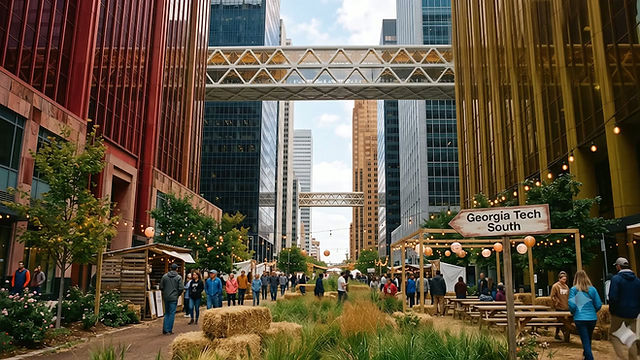
By moving vehicles overhead, eventually, Atlantans will remove cars from the ground in downtown, reclaiming the surface level for work surrounded by nature, walking through green space, and outdoor dining.
How soon before Level 2 skyways are feasible?
Returning to the Source: The Benefits of Structural Oneness

Peachtree Corners
Sandy Springs
Buckhead
Midtown
Downtown
Cumberland
It's still hard for most people to believe the traditional boundaries of transportation and community could ever be recovered.
For Atlantans, it began generations ago, with the smashing of the city's creative core into a scattered ring, distinct zones forged over time. They discovered fragmented creative districts were too weak and divided to scale talent agglomeration in these smaller mini-cities. For their powers to work, there could only be one master core.
Until better technology could be found, city leaders encouraged more people to use trains and buses to maximize the flow of commuters. Dense infill housing and mixed use developments were built in downtown and its surroundings, while newer office districts, isolated into different parts of the city, kept growing further apart during rush hour, holding out, eager to one day reunite and regain what was lost: one hub for the city’s creative class to meet, struggle, and share niche industry knowledge.
Peachtree Corners: Best place for Atlanta's Future Downtown?

Peachtree Corners, paired with swaths of Norcross and Doraville, could be the location uniquely positioned to become Atlanta's next Central Business District (CBD). Here are five big reasons.
1. The Proximity to Atlanta's Real Population Centroid
Downtown and Midtown are increasingly geographic outliers to the region's talent pool. Doraville and Peachtree Corners sit closer every year to where the people actually live.
2. Flat Topography and the "Loose" Grid of Peachtree Corners, Doraville, and Norcross
3. Number one potential for Rails-to-Trails
-
Macro-Infrastructure: Doraville also sits directly at the apex of Spaghetti Junction (I-85 and I-285), and this district includes Peachtree Industrial, Peachtree Parkway, and other major artieries which could be upgraded to bring massive volumes of traffic, just like Downtown, from every direction.
-
Micro-Mobility (Rails-to-Trails): The region is rich with historic rail spurs and right-of-way corridors primed for greenway conversions. Projects like the expanding Peachtree Creek Greenway and local technology park trail master plans can act as a parallel, human-only highway system. While AVs dominate the asphalt corridors, bikes, e-scooters, and pedestrians move completely uninterrupted through dedicated linear parks.
4. Ideal access to water from the Chattahoochee River
5. Institutional Hunger vs. Incumbent Inertia
If Downtown and Midtown are burdened by rigid zoning structures, layers of bureaucratic inertia, and the ongoing struggle to manage legacy problems, then retrofitting an ancient, dense urban core for an AV future will be an engineering and financial nightmare.
Peachtree Corners features vast swaths of low-slung, mid-century commercial strips, underutilized surface parking lots, and spread-out 1980s corporate parks (such as areas of Technology Park), enabling developers to build an entire ecosystem from scratch:
Peachtree Corners and Doraville, conversely, are aggressively hungry for identity and comeuppance. Peachtree Corners has already established itself globally via the Curiosity Lab, a real-world smart city proving ground operating autonomous shuttles on public roads alongside everyday traffic. Doraville has proved its appetite for massive transformation through the redevelopment of the former GM Assembly plant into a massive film and mixed-use hub.
This localized agility means municipal leaders are willing to rewrite zoning codes overnight to favor AV implementation—offering a friction-free regulatory sandbox that the historic urban core has not matched.

-
Black Lines - Autonomous Grid Framework
-
Yellow Lines - Proposed First Elevated Routes
-
Light Green Lines - Potential Linear Parks (Rails-to-Trails)
-
Blue-Green Lines - Potential Linear Parks (Creek-Beds-to-Trails)
Peachtree Corners' Potential Near-Term Autonomous Grid Framework is also available:
Could this be the Future of Peachtree Corners?

Atlanta's traditional core has one advantage Peachtree Corners will never have. Its place at the heart of the old city means each generation will think of Downtown and Midtown as the center of Atlanta.
Downtown Atlanta: Best core to rule them all?

In the age of skyscrapers, Old Atlanta's early rejection of its diagonal ridges has never been more important.
Atlanta also paid a price early on which Peachtree Corners and Doraville did not, evident in the awkward angles around Five Points--Atlanta's street grid was radically turned from its diagonal origins to the North-South-East-West grid we know today. This maximizes sunlight on the street, making Atlanta's grid better for tall buildings.
Hear the Future Sound of Downtown

The previous tradeoffs between economic competitiveness and pedestrian design are blown away by elevated autonomous routes: clean, quiet, and enhancing the urban fabric. If planned linear parks are built beneath autonomous routes, it will transform our ability to walk to work and move free and dry underneath these structures on rainy days (or hot days), while replacing the roar of wind and engines with the quiet hum of synchronized movement of AVs and smartly-designed acoustics directing the wind to the space. During the day, the downtown soundscape will be dominated by the voices of coworkers and neighbors. During summer, the loudest sounds in downtown, if not crickets and cicadas, will be the sounds of children, or else the distant hum of air conditioner units, as well as the sound of footsteps below.
The spaces beneath these paths can be affordably designed to be the most vibrant, well-lit, and highly activated corridors in the district—providing all-weather protection for cyclists, smart lighting for pedestrians, and new spaces for local small businesses.
Reclaiming Downtown Ground

Atlantans will witness a system moving in symmetry to witness harmony made physical. One autonomous route after the next is added, operating on synchronicity, lifting more of commuting vehicles from the pedestrian grid below, moving Atlantans from every neighborhood in an expanding fluid system, like a continuous stream, the infrastructure communicating instantly, merging patterns and speeds adjusting, preventing traffic bottlenecks from forming, as Atlanta’s office workers, students, and fun-seeking tourists gliding through space without friction.
Building this network of elevated autonomous vehicle (AV) thoroughfares would not just an engineering upgrade, but a powerful mechanism for reclaiming the lost creative energy of daily commuters, the lost urban spaces once for families, and the lost personal autonomy of pedestrians.
Atlanta's historic identity as a "city in a forest" has been severely fractured by massive swaths of asphalt designed to store and move internal combustion engines. But a foundational tenet of many Atlanta traditions is for the care of creation—the responsibility to tend to our physical environment and live in harmony with creation.
Atlanta has always been a city of forward momentum not because there were never any mistakes, but because its people embraced each other's resurrection. By lifting commuters into the sky, we don't just solve a traffic problem; the ground level of Downtown and Midtown to be reborn as a terrestrial sanctuary. We elevate our collective quality of life, realigning our daily geometry with peace, safety, and a deep reverence for the human spirit.
In the long run, the asphalt on some roads can be unpaved and replaced with lush gardens, and continuous canopies of oak and dogwood trees. The street level could return to the creative pedestrians, the cyclists, the children, and the infirm, inviting the natural world back to Atlanta's downtown corridors, directly fostering a daily, grounded connection to nature, lifting the burden of the mechanical gridlock off the earth, and turning our daily transit into a peaceful journey.
First Mover Advantage
The first metropolis to offer seamless, rapid, driverless transit between its major financial, academic, and convention districts could win the next half-century of corporate relocations.
What started as an effort to reunite the city could turn into something more challenging, as capital follows frictionless infrastructure. Building this network before other metropolitan areas could create a defensible competitive moat, establishing Atlanta as the premier global testbed for next-generation vehicle-to-infrastructure (V2I) communication systems and structural engineering models, drawing billions in venture capital and engineering talent away from Silicon Valley, Boston and Wall Street.
How would Atlanta's Level 2 autonomy-enabled Downtown compare to the world's biggest?

By 2050, Atlanta's CBD could have one million workers commuting in and out every workday, becoming the second city potentially to do so. Today, nearly a million commuters move in and out of Midtown Manhattan each work day into 400 million square feet of office space.
Eventually, a ubiquity of fully matured systems (Level 4, sub-second reaction times) could deliver tens of millions of autonomous vehicles into central business districts that could expand towards 80 square miles.
The city planning implication is the cities which will thrive in the new era will be the ones who plan now in order to make the right investments, zoning changes, and priorities of how to use their limited space. Work could be done now to smooth permitting and construction and provide clarity to real estate developers, architects, and investors. For Atlanta, either the current commercial core of Midtown/North Downtown Atlanta, Sandy Springs, and Buckhead are the strongest candidates to be the anchor of this new central business district.
Architects and Investors want to know:
Where to build new high-rises?

-
Blue Lines + Pink Lines - Autonomous Grid Framework
-
Yellow Lines - Proposed First Elevated Routes
-
Green Lines - Linear Park Trails
-
Black Lines - Pedestrian paths, but also capable of handling moving trucks and cranes, etc.
-
Small Colorful Boxes - Clusters of where 2000 potential tall buildings could eventually go in more expansive, high velocity L3-L4 systems
To Open the Full Near-Term Model:
But Atlanta's Downtown Street Grid is not straight and consistent enough for an autonomous grid in the long-run

But Atlanta has a long time, between fifty and one hundred years, before autonomous tech is so advanced, ubuitous and cheap that its higher speeds will become a problem for Atlanta's crooked streets.
Only tall buildings last for centuries with minimal maintenance. Commercial and residential properties built from wood frame (typical for buildings with less than five stories) are not designed to last more than fifty years. Even parking garages (despite being made of steel and concrete) are not designed to last more than fifty years. If Atlanta designs both a five year plan and a fifty year plan, the city's core properties can be realigned as they are repurposed over time. If planned smartly and early, few if any buildings will need to experience an early demise, giving Atlantans time to steadily and seamlessly adjust.
See Autonomous Symmetry's Draft Proposal for an autonomous grid in Atlanta